Application guide
Cold galvanizing succeeds or fails at the surface.
The coating is simple to apply, but it is unforgiving of insulating contamination, poor agitation and inadequate film build. The correct sequence is clean metal, uniform zinc suspension, controlled coating, DFT verification and cure.
Recommended build sequence
Read with the current GalvoKote TDS and project specification.
Inspect the substrate
Identify mill scale, red rust, white rust, old coating, grease, salts, weld spatter and inaccessible geometry. Decide the preparation method before opening the can.
Remove salts and oil
Wash soluble salt contamination appropriately and degrease. The coating guide stresses that even invisible chlorides and sulphates can undermine coating performance.
Expose clean metal
Where specified, abrasive blast steel to ISO 8501-1 Sa 2½ and the required profile. For galvanized maintenance, select preparation suitable for the actual condition and project specification. Apply before flash rust or recontamination develops.
Mechanically agitate
Zinc is extremely dense and settles. Use a power paint mixer until the bottom sediment is fully reincorporated and the density is uniform. Re-agitate during longer application periods if settlement begins.
Apply directly to metal
Brush, roller, conventional spray or airless spray can be used. For airless spray, use a tip above 0.017 in, pressure above 20 MPa and a #50-60 gun filter. Do not insert a conventional primer between the zinc-rich coating and the substrate.
Build the first 40 µm DFT
Avoid over-spreading. The GalvoKote specification’s two-coat system targets 40 µm dry film in each coat.
Allow the coating interval
Use the approved 1-2 hour interval when the first coat is dry and sound. Temperature, relative humidity, ventilation and film build affect recoating; touch dry is not the same as ready to recoat.
Apply the second 40 µm
Complete the target 80 µm total DFT. Edges, welds, bolt heads and complex geometry need particular attention because they are easy to leave thin.
Measure DFT
Use a calibrated electromagnetic dry-film thickness gauge suitable for ferrous substrates. Recoat thin areas rather than assuming visual coverage is enough.
Allow cure and protect the work
Allow 24 hours for full cure at reference conditions; drying varies with temperature, humidity, ventilation and film build. Avoid premature service or contamination.
Topcoat compatibility
Direct application of alkyd-based topcoats is not recommended. Acrylic and other organic resin-based topcoats may be used after confirming compatibility of the complete coating system.
Common site failures
Most problems are application errors, not mysteries.
When a high-zinc coating is placed over rust, old paint or contamination, or when it is spread too thin, the result may look grey while the electrochemical system is already compromised.
Painting over old coating
Electrical contact is broken. Remove the insulating layer where the zinc coating must provide galvanic action.
Insufficient mixing
Zinc settles to the bottom. The upper liquid can become zinc-deficient while the remaining material becomes overloaded and unworkable.
One thin cosmetic coat
Coverage colour is not DFT. The recommended system is two coats totaling 80 µm dry film.
Moist or salty steel
Trapped contamination and poor adhesion can accelerate under-film failure.
Wrong thinner
Never add petrol or kerosene. If thinning is necessary, use xylene only, to a maximum of 10% of the coating quantity.
No thickness inspection
Edges, welds and spray shadows frequently fall below target. Measure them.
Primary product
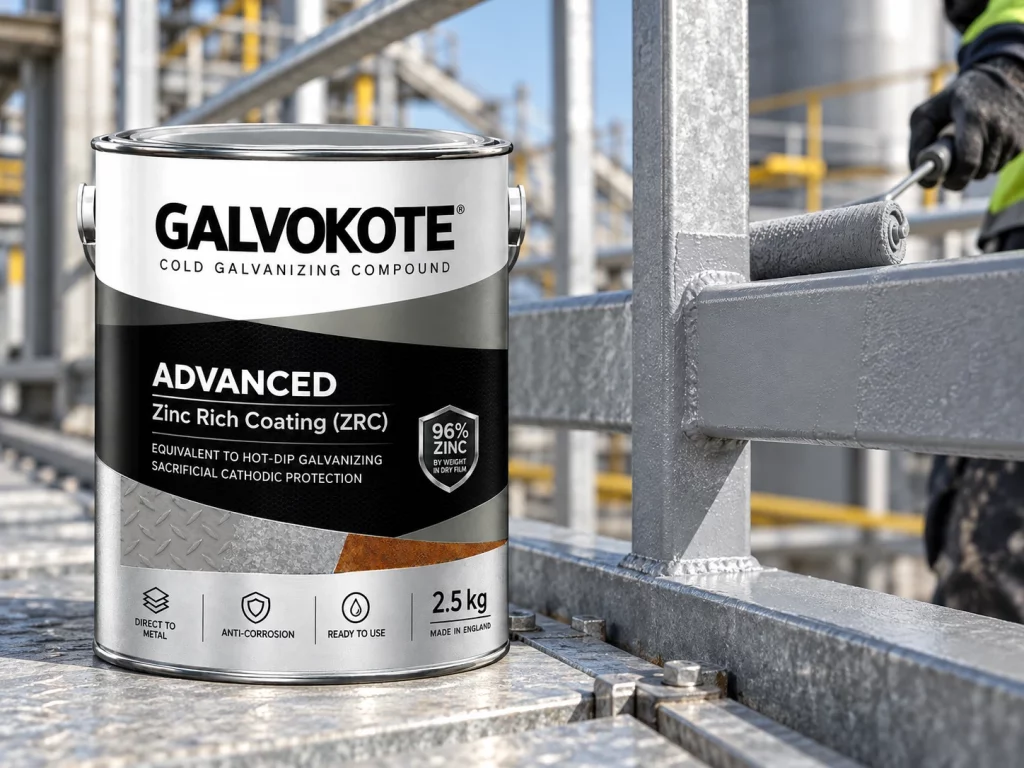
Buy GalvoKote Cold Galvanizing Compound — 2.5 kg.
View the single official product page for current Pakistan pricing, availability, nationwide courier booking and Lahore collection.